
When comparing cigarette packaging in Canada, one of the most common questions is how many cigarettes come in a pack and how many are included in a full carton. Although the answer is straightforward in many cases, the total can depend on the number of cigarettes inside each individual pack and how those packs are grouped together.
A common carton contains 200 cigarettes, but there is more than one way to arrange that quantity. For example, a carton may contain 10 packs of 20 cigarettes or eight packs of 25 cigarettes. Both configurations add up to the same total, even though the number of individual packs differs.
Understanding these quantities makes it easier to read product descriptions, compare packaging formats and calculate the total number of cigarettes represented by a particular listing. Whether you are researching individual packs, cartons or larger packaging units, the most reliable approach is to check the stated quantity rather than relying on the package’s appearance alone.
How Many Cigarettes Are in a Pack in Canada?
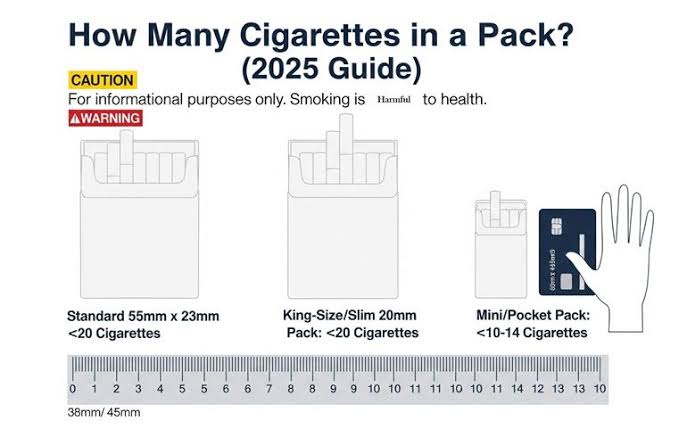
A cigarette pack is the individual package that holds the cigarettes. The number inside can vary by product, so it is important to check the pack information when identifying a particular format.
Two quantities commonly discussed when comparing cigarette packaging are 20 cigarettes and 25 cigarettes per pack. These different formats can affect how many individual packs are needed to make up a carton.
For example, a pack containing 20 cigarettes has five fewer cigarettes than a pack containing 25. However, this difference does not necessarily mean that a carton containing 20-cigarette packs has fewer cigarettes overall. The number of packs inside the carton also matters.
Consider the following examples:
- A pack containing 20 cigarettes has 20 individual cigarettes.
- A pack containing 25 cigarettes has 25 individual cigarettes.
- Ten packs containing 20 cigarettes each add up to 200 cigarettes.
- Eight packs containing 25 cigarettes each also add up to 200 cigarettes.
This distinction is useful when reading product descriptions because the number of cigarettes in an individual pack and the number in a complete carton are two separate measurements.
How Many Cigarettes Are in a Carton in Canada?
A common cigarette carton in Canada contains 200 cigarettes. The total is usually reached by combining several individual packs into one larger package.
The two familiar configurations are 10 packs of 20 cigarettes and eight packs of 25 cigarettes. Both provide the same total quantity, but they differ in the number of packs included.
| Carton configuration | Cigarettes per pack | Number of packs | Total cigarettes |
|---|---|---|---|
| Configuration A | 20 | 10 | 200 |
| Configuration B | 25 | 8 | 200 |
The calculation is simple:
Number of packs × cigarettes per pack = total cigarettes
For a carton containing 10 packs of 20 cigarettes, the calculation is 10 × 20 = 200.
For a carton containing eight packs of 25 cigarettes, the calculation is 8 × 25 = 200.
These examples demonstrate why it is useful to look beyond the number of packs when comparing cartons. A carton containing eight packs is not necessarily smaller in total quantity than one containing 10 packs.
The exact configuration should always be confirmed through the product description or packaging information.
What Is the Difference Between a Pack, a Carton and a Case?
Packaging terminology can sometimes cause confusion because the words are not always used consistently in product listings. Understanding the basic distinctions helps clarify the quantities being described.
Individual cigarette pack
A pack is the smaller retail package containing a specified number of cigarettes. Common examples include packs of 20 and packs of 25.
The quantity stated on the package is the most useful starting point when calculating the total number of cigarettes in a larger unit.
Carton of cigarettes
A carton groups multiple individual cigarette packs together. A common carton contains 200 cigarettes, although the number of packs used to reach that total can differ.
For instance, 10 packs of 20 and eight packs of 25 both produce a total of 200 cigarettes. The carton quantity is therefore best understood by checking both the number of packs and the quantity inside each pack.
Case or larger packaging unit
A case generally refers to a larger packaging or shipping unit that may contain several cartons. Unlike the common 200-cigarette carton, a case does not have one universal cigarette count.
Its total depends on the number of cartons or other packages inside. When a listing uses the term case, check the supplier’s stated quantity rather than assuming that it means the same thing as a carton.
These distinctions are useful in everyday product research because they prevent confusion between the quantity in a single pack and the quantity in a larger packaging unit.
How to Calculate the Total Number of Cigarettes
Calculating the total number of cigarettes in a pack or carton does not require complicated mathematics. You only need to identify two figures: the number of packs and the number of cigarettes in each pack.
Once those figures are known, multiply them together.
For example, imagine a package containing 10 individual packs, with 20 cigarettes in each pack. Multiplying 10 by 20 gives a total of 200 cigarettes.
Now consider a different package containing eight packs, with 25 cigarettes in each. Multiplying eight by 25 also gives 200 cigarettes.
This method works regardless of the product name or packaging design. It can be used to check a written description, interpret a quantity label or compare two different packaging formats.
It is also helpful when a product listing uses shorthand such as “10 × 20” or “8 × 25.” The first number indicates the number of packs, while the second indicates the number of cigarettes in each pack.
For example:
| Description | Meaning | Total |
|---|---|---|
| 10 × 20 | 10 packs of 20 cigarettes | 200 |
| 8 × 25 | 8 packs of 25 cigarettes | 200 |
| 5 × 20 | 5 packs of 20 cigarettes | 100 |
| 4 × 25 | 4 packs of 25 cigarettes | 100 |
The last two examples illustrate the same principle on a smaller scale. Knowing the quantities makes it easier to understand packaging without needing to estimate from photographs or physical dimensions.
Why Do Cigarette Carton Quantities Differ?
One reason carton descriptions can look different is that manufacturers do not always use the same number of individual packs to reach a particular total.
A carton containing packs of 20 requires more individual packs to reach 200 cigarettes than a carton containing packs of 25. This affects the carton layout and how the individual packs are arranged inside the outer packaging.
Packaging dimensions can also vary. A carton may look taller, wider or more compact depending on the size and arrangement of the packs inside. However, physical appearance alone is not a dependable way to determine the total number of cigarettes.
Another source of confusion is terminology. Some people use the words box, pack, carton and case interchangeably in casual conversation. In product descriptions, however, those words can refer to different quantities.
Product names can also distract from the actual count. A description may emphasise the brand, cigarette style or packaging design without making the total quantity immediately obvious.
The best way to resolve these differences is to look for an explicit pack count, the number of cigarettes per pack and the total quantity. These three details provide a clearer understanding than packaging appearance alone.
How to Compare Cigarette Pack and Carton Quantities
When reading different product listings, it helps to compare equivalent quantities. Looking at two products with different pack sizes without calculating the total can lead to an inaccurate comparison.
Start by checking the number of cigarettes in each pack. A 20-cigarette pack and a 25-cigarette pack do not contain the same quantity, even if their packaging looks similar.
Next, identify the number of individual packs included in the carton. Multiply that figure by the cigarettes per pack to calculate the total.
For a more focused explanation of carton quantities and how the different pack configurations add up, explore how many cigarettes in a carton.
Finally, look for any wording that describes a larger case or another packaging unit. If the description does not clearly state the quantity, do not assume that it refers to a standard carton.
For example, two listings may use different descriptions but represent the same total quantity. One might identify 10 packs of 20 cigarettes, while another identifies eight packs of 25. Once the calculations are completed, both can be understood as containing 200 cigarettes.
This approach is useful for reading product catalogues, comparing packaging specifications and understanding how quantities are presented across different websites.
Common Mistakes When Counting Cigarettes in a Carton
One common mistake is assuming that every carton contains the same number of individual packs. Although 200 cigarettes is a familiar carton quantity, the number of packs can differ depending on the number of cigarettes in each pack.
Another mistake is counting the packs without checking their contents. Eight packs of 25 cigarettes and eight packs of 20 cigarettes do not represent the same total. The pack quantity must be considered alongside the number of cigarettes per pack.
It is also easy to confuse a carton with a case. A carton typically groups individual cigarette packs together, while a case may refer to a larger shipping unit. The quantity represented by a case depends on its stated contents.
Finally, do not rely entirely on product photographs. Images may show packaging from a different version or fail to reveal all the relevant quantity details. Written specifications are generally more useful for confirming the total.
Paying attention to these details makes it easier to understand the quantity being described and reduces the risk of misinterpreting a product listing.
Frequently Asked Questions
How many cigarettes are in a standard carton in Canada?
A common carton contains 200 cigarettes. One familiar configuration is 10 packs of 20 cigarettes, while another is eight packs of 25 cigarettes. Check the particular product’s packaging to confirm its exact quantity.
How many packs are in a carton of cigarettes?
A common carton contains either 10 packs of 20 cigarettes or eight packs of 25 cigarettes. The number of packs depends on how many cigarettes each individual pack contains.
Are 20-cigarette and 25-cigarette packs the same?
No. A pack of 20 contains 20 individual cigarettes, while a pack of 25 contains 25. However, cartons made up of these different pack sizes can still contain the same total quantity.
How do you calculate the number of cigarettes in a carton?
Multiply the number of individual packs by the number of cigarettes in each pack. For example, 10 packs multiplied by 20 cigarettes equals 200 cigarettes.
Is a carton the same as a case?
Not necessarily. A carton generally contains multiple individual cigarette packs, whereas a case may be a larger shipping or packaging unit containing multiple cartons. The stated quantity should be checked to understand what a particular listing means.
Why should I check the quantity on a product listing?
Product descriptions and packaging formats can vary. Checking the number of packs, the cigarettes per pack and the total quantity helps clarify exactly what the description represents.
Final Thoughts
Understanding cigarette packaging quantities in Canada comes down to a simple distinction between an individual pack and a larger carton. A pack may contain 20 or 25 cigarettes, while a common carton contains 200 cigarettes arranged in different pack configurations.
The important thing is to check the numbers rather than relying on the number of packs or the appearance of the packaging. Multiplying the pack count by the cigarettes per pack provides a straightforward way to calculate the total.
Whether you are reading a product catalogue, comparing packaging descriptions or simply trying to understand common cigarette quantities, these basic calculations make the terminology easier to follow.







Leave a Reply